Tuesday, April 30, 2013

The Battle of Chancellorsville, 1863

When Union Maj. Gen. Joseph Hooker crossed the Rappahannock on this date in 1863, he placed his Army of the Potomac on Confederate Gen. Robert E. Lee’s vulnerable flank. His advance would signal the beginning of the 7-day Battle of Chancellorsville.

Rather than retreat before Hooker's sizable Federal force, (130,000 Federals to Lee's 60,000) Lee opted to risk an attack against Hooker while he was still within the thick wilderness. Late the following day, Lee and his Lt. Gen. Thomas "Stonewall" Jackson conceived one of the boldest plans of the war. Jackson, with 30,000 Confederates, would follow a circuitous route to the Union right and from there conduct an attack on that exposed flank.

Jackson, having completed his legendary circuit around the enemy, unleashed his men in an overwhelming attack on Hooker's right flank and rear on May 2. His attack stunned the Union XI corps and threatened Hooker’s position, pushing the Northern army back more than 2 miles.

Tragically, the victorious Confederate attack ended with the mortal wounding of Stonewall Jackson, mistakenly fired on by his own men. Jackson, with 8 other Confederate horsemen, were riding forward through the dense woods and thickets on the night of May 2. Returning towards the Confederate lines, his party came under fire from combat-weary Confederates. Jackson was struck by 3 different balls. As he was being evacuated, his litter bearers stumbled and dropped the general twice, further worsening his loss of blood. Later that night, Jackson’s left arm was amputated, and he was subsequently evacuated to Guinea Station, where he died of pneumonia eight days later.

On May 3, 1863, the Confederates resumed their offensive and drove Hooker’s larger army back to a new defensive line nearer the fords. Swinging east, Lee then defeated a separate Federal force near Salem Church, just west of Fredericksburg, that had threatened his rear. Lee went to the fight in person to ensure final success on the 4th, then returned to Chancellorsville to mop up Hooker's defeated army.  With nowhere else to go, on May 6th, Hooker recrossed the Rappahannock River from where he had come 6 days earlier.

Having been outnumbered more than 2 to 1, Lee's victory at Chancellorsville is widely considered to be his greatest. The campaign had cost him about 13,000 casualties, but his enemy about 18,000. However, none of the losses on either side would resonate as loudly and long as the death of Stonewall Jackson. As Jackson lay dying, Lee sent a message, saying "Give General Jackson my affectionate regards, and say to him: he has lost his left arm but I my right." On his death bed, remaining spiritually strong, although he was growing physically weaker, the godly warrior said, "It is the Lord's Day; my wish is fulfilled. I have always desired to die on Sunday."

Source: Civil War Trust; Wikipedia

_______________________________________________________________________

During Chancellorsville Campaign, Confederate Gen. Braxton Bragg was readying his Army of Tennessee in the area around Tullahoma, Tennessee. To view my blog about Great Grandfather Nathan Oakes and the 32nd Mississippi Infantry Regiment of Bragg's army, please visit: http://32ndmississippi.blogspot.com
_______________________________________________________________________

Sunday, April 21, 2013

Dad qualifies as Diver, Second Class

On this date in 1943, my dad, Frank Dolan, already a Metalsmith, First Class (M1c), qualified as a Diver, Second Class. Since his repair ship, Vestal, had a full allowance of divers at this time, he was not detailed to any diving duties, although from time to time, he will work on the diving crew.

Source: Frank L Dolan's Service Records

Wednesday, April 10, 2013

Repairs to USS Adhara

On today's date in 1943, Dad's repair ship, Vestal, began emergency repairs to the cargo ship, USS Adhara.

While at Guadalcanal on April 7, Adhara was among several ships subjected to a Japanese air attack. At least 4 enemy planes dropped as many as 8 bombs, several of which exploded alongside Adhara, their fragments puncturing her hull in 3 places. According to the official report, the force of the explosions caused the ship to "lift bodily out of the water," and to damage cargo and 8 personnel. 1 CB temporarily attached to the ship was killed and buried at sea. She was also strafed by machine gun fire.

At Espiritu Santo, Vestal's weldors provided emergency patching to the bomb-damaged hull, working on her until at least the 17th. Then the stricken ship steamed to Australia for more repairs until it could sail for the West Coast in July for an overhaul.

Launched on October 27, 1942, Adhara served as a member of Service Squadron 8, transporting cargo and passengers between ports. After her overhaul in 1943, she served throughout the Pacific, participating in the Battle of Okinawa in May 1945. After Japan's surrender in August 1945, she returned to the States. Adhara was decommissioned on December 7 of that year, and like so many of her sister ships, she eventually was sold for scrap in 1971.

Adhara distinguished herself with 2 Battle Stars for her WWII service.

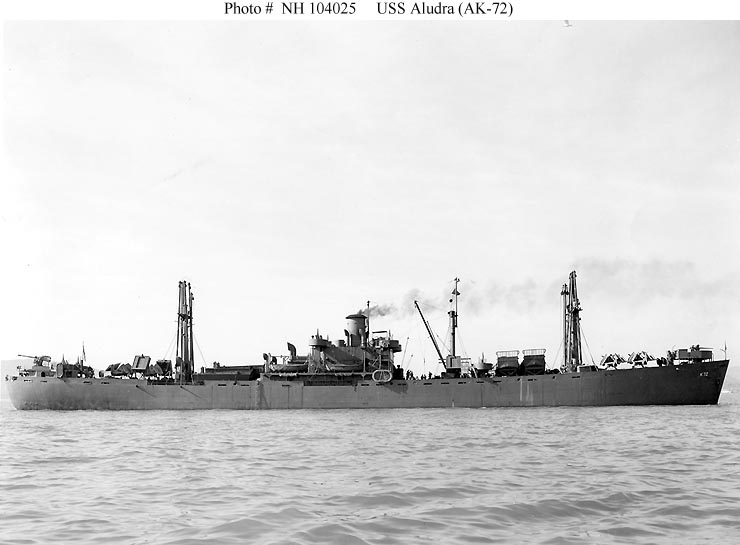
USS Adhara, after repairs at Mare Island Navy Yard, 1943
Source: NavSource Online

Source: Vestal War Diary, April 1943; Adhara War Diary, May 1943

Tuesday, April 9, 2013

Repairs to the USS Tappahannock

On today's date in 1943, Dad's repair ship, Vestal, began repairs to the fleet oiler Tappahannock for damage it received in a Japanese air attack on April 7. Vestal also repaired damage from an earlier accident on April 1, when a seaplane from the Enterprise crashed into the oiler's mainmast, damaging its radar tower and antenna. Vestal will work on this ship into June.

Tappahannock was one of many ships supporting operations in the Guadalcanal area as the American forces fought to consolidate their hold on the bitterly contested Solomon Islands. On April 6, Tappahannock was transferring fuel and oil off Guadalcanal, when Japanese aircraft attacked, dropping a few bombs astern of the ship, but causing no damage. The actual damage to the ship would come the next day.

On April 7, Allied ships in the harbor received an order to get underway immediately. The Japanese were making a final thrust against the U.S. Navy in the Solomons, and an attack was imminent. Tappahannock sailed into a portion of this enemy attack force, becoming the main target of Japanese dive bombers. The first enemy bomb hit near the bridge. Tappahannock's gunners concentrated their fire on the attacking plane, sending it into the water. As the ship fought to get underway again, a second plane concentrated its fire on the ship but was driven off.

As the Tappahannock's engineers were getting the ship underway for a third time, she faced a third attacker, which came in directly astern. The Japanese pilot misjudged his target's speed and ended up dropping his bomb very near the ship without damaging it. A fourth enemy plane followed and was hit from the ship's fire, tearing pieces from the plane and sending it into the water, its bomb exploding off the oiler's starboard side. The fifth and final enemy plane crossed the ship, dropping its bomb alongside, causing some denting to the ship's hull plating. As suddenly as it had begun, the attack was over.

The stricken oiler then sailed to Espiritu Santo so that repair crews from Vestal could repair her topside damage and patch her hull below the waterline. After repairs had been completed, Tappahannock resumed active service supporting American forces to strengthen their hold on the Solomon Islands.

For the remainder of the war, Tappahannock conducted vital fueling duties for the Fleet as it fought westward and northward against the Japanese empire. She supported operations from the Gilbert Islands to Okinawa. Later, she supported the actions to take other Japanese Islands, and aided the fast carriers in their raids on the Bonins, Philippines, and Formosa. For the remainder of the war, Tappahannock supported the fast carrier task forces in the Pacific, including action against the Japanese homeland.

In 1950, Tappahannock was decommissioned, but she was brought back into action in the face of the Korean threat from 1950-1955. She was decommissioned again in 1955, but almost immediately returned to service from 1956-1957. She would see service once more, from 1966-1970, this time to support the U.S. involvement in the Vietnam conflict. Tappahannock was decommissioned for the last time in 1970 and was disposed of in 1987.

USS Tappahannock refueling USS Bonhomme Richard & USS Missouri, July 1945
Source: NavSource Online

Launched in 1942, Tappahannock was one of just a few WWII ships that saw a long lifetime of active and distinguished service. She received 9 Battle Stars for World War II service and 9 for service in the Vietnam War.

Source: Vestal War Diary, April 1943; Wikipedia

Monday, April 8, 2013

Margaret Thatcher, Britain's Iron Lady, dead at 87


Source:  ABC News.com

Baroness Thatcher, the first woman to lead a Western democracy, died peacefully following a stroke this morning. She was 87. The "Iron Lady" led Great Britain as prime minister from 1979 to 1990. She was a champion of small government and the free-market. And with her friend Ronald Reagan, she stood against the Soviet Union, bringing an end to the Cold War.

President Reagan called her the "best man in England." Not one to be outdone, she referred to him as "the second most important man in my life."

Thatcher's words frequently rose to the level of memorable. Here are a few of my favorite quotes:
“In politics, If you want anything said, ask a man. If you want anything done, ask a woman.”
“Being powerful is like being a lady. If you have to tell people you are, you aren't.”
“Europe was created by history. America was created by philosophy.”
“The problem with socialism is that you eventually run out of other people's money."
“There are significant differences between the American and European version of capitalism. The American tradition emphasizes the need for limited government, light regulations, low taxes and maximum labour-market flexibility. Its success has been shown above all in the ability to create new jobs, in which it is consistently more successful than Europe.”
“No-one would remember the Good Samaritan if he'd only had good intentions; he had money as well.”
“Consensus: “The process of abandoning all beliefs, principles, values, and policies in search of something in which no one believes, but to which no one objects; the process of avoiding the very issues that have to be solved, merely because you cannot get agreement on the way ahead. What great cause would have been fought and won under the banner: ‘I stand for consensus?'”
“I am extraordinarily patient, provided I get my own way in the end.” 
“Watch your thoughts for they become words.
Watch your words for they become actions.
Watch your actions for they become habits.
Watch your habits for they become your character.
And watch your character for it becomes your destiny.
What we think, we become.
My father always said that... and I think I am fine.”

Monday, April 1, 2013

Promoted to Metalsmith, 1st Class


On this date in 1943, my dad, Frank Dolan, was appointed Metalsmith Welder, 1st Class. From repair ships like the Vestal on which he served, Dad and other metalsmiths routinely repaired and constructed metal equipment aboard various ships. They maintained and repaired ventilating and drainage systems, tested and replaced watertight gaskets, heat-treated and case-hardened metals, and cut, welded, and riveted metal parts. Of course, metalsmiths also worked with damage repair parties on battle-damaged ships and other naval craft, which in wartime was their primary task.

Sunday, March 31, 2013

This Joyful Eastertide

This joyful Eastertide,
Away with sin and sorrow!
My Love, the Crucified,
Hath sprung to life this morrow.

Had Christ, that once was slain,
Ne'er burst his three-day prison,
Our faith had been in vain:
But now hath Christ arisen,
arisen, arisen, arisen.


My flesh in hope shall rest,
And for a season slumber:
Till trump from east to west
Shall wake the dead in number.

Death's flood hath lost his chill,
Since Jesus cross'd the river
Lover of souls, from ill
My passing soul deliver.

—George Ratcliffe Woodward, 1848-1934

Listen to this beautiful Easter hymn performed by the King's College Cambridge on YouTube

March's routine repairs

In the month of March 1943, stationed in Espirito Santo, in addition to major emergency repairs to Alchiba and the overhaul of American Legion and Hunter Liggett, Dad's ship, the Vestal, continued to tackle numerous "routine not alongside repairs" to various vessels of the fleet. In relative order of service and repair, these ships included: Enterprise, Pyro, Tangier, Taurus, Curtiss, Tangier, Heosho, St. Louis, Honolulu, Nashville, San Diego, Pickney, Vireo, George Clymer, Joliet, David Gailland, SS Mathews, Walter Colton, SS David Gaillard, YMS-47, YMS-48, YMS-88, Cetus, Nassau, Sands, Cassiopeia, Pyro, Edwin Booth, Arctic, Peter V. Daniel, Nautilus, Andrew Furuseth, plus the Shore Station and various shop jobs on ships in the harbor.

Source: USS Vestal War Diary, March 1943

Thursday, March 7, 2013

James D. Doss (1939-2011)

For several months, I've been on my library's waiting list, anxiously anticipating the arrival of James D. Doss's latest mystery novel, The Old Gray Wolf. Alas, the first thing I read on the book jacket last night was that my favorite mystery writer had passed away. I can hardly bring myself to read this 17th and final installment.

James D. Doss was born and raised in Kentucky. He was an electrical engineer who worked on particle accelerators and biomedical technology at the Los Alamos National Laboratory while writing his novels. After retiring in 1999, he continued writing until his death in Los Alamos on May 17, 2012. Doss authored 17 “Charlie Moon Mysteries,” the first published in 1994, and the last of which was completed shortly before his death.

Doss thoroughly researched the background for his books about Southern Colorado and the Ute tribe in particular. Each story centers around tribal investigator Charlie Moon and his irascible but endearing Aunt Daisy, his only living family. Doss's tales are enriched by humorous descriptions of Charlie's devotion to his snappish and shameless aunt. But they also recount the enduring friendship between Charlie and his best "pardner," Granite Creek's chief of police, Scott Parris, with whom Charlie shares his investigations. And these relationships are what I will miss most.

Informed by a sincere respect for the culture and myths of the Utes, Doss mixed local culture, compelling narrative, and sly humor to make his books favorites among fans of the genre and readers of all kinds. Sadly, that has come to an end all too soon.

Thanks for giving us such satisfying and memorable stories. May they live on.

Tuesday, March 5, 2013

Alice Thompson, Heroine of Thompson Station

17-year old Alice Thompson
"Heroine of the Battle of Thompson Station"
Source: Battles and Sketches of the Army of Tennessee, 1906
There is a fascinating story forever associated with the Civil War Battle of Thompson's Station, Tennessee, fought on this date in 1863. The Confederate cavalry, victorious in that battle, received critical help from an unlikely source, a 17-year old named Alice Thompson. No recounting of the battle would be complete without mentioning the heroic role she played.

Daughter of Elijah Thompson, the town's eponym, Alice was on her way to visit a neighbor when Confederate and Federal troops collided in her small community. As the fighting approached, she dashed for the nearest safe place, the basement under the Thomas Banks home, where she sheltered with the family. Alice and the frightened family witnessed some of the fiercest fighting of the day, watching through the small windows for several hours as the battle raged around them. Alice looked on as Confederate soldiers charged towards a nearby hill and were repulsed. It was the dismounted 3rd Arkansas Regiment of Armstrong's Brigade. The soldiers charged again, but were repulsed a second time. In this attack, the regiment lost its commander, Col. S.G. Earle, shot in the head while leading his brave men. The regimental color-bearer was also struck. Both events left the troops in obvious disorder.

What Alice did next was simply astounding.

When she saw the regimental color-bearer down, brave Alice bolted from her shelter, snatched up the banner, and began waving it to rally the troops. Seeing such valor displayed by one of their women, the Confederates charged again, and this time they took the hill. Even the enemy cheered her heroism. After the battle, Alice tended many of the wounded who were taken into the Banks house.

Alice's deed that day made quite a lasting impression. It's referenced in a number sources by many witnesses. One such example is that of esteemed cavalry colonel, W.S. McLemore, who years after the war recalled Alice's bravery in the book, Battles and Sketches of the Army of Tennessee. While he admitted that many of the war's details had been forgotten, he could not forget the "heroine at Thompson's Station." For the book's publication in 1906, another vet provided the author with a picture he saved of the young woman.

Alice later married Dr. David H. Dungan, the brigade surgeon she assisted at the hospital set up in the Banks home after the battle. Sadly, Alice enjoyed only a short life, dying in 1869 at the age of 23. She is buried in her family's cemetery at Thompson's Station. Their home was just north of Banks house (now Homestead Manor) on the opposite side of the road.

Reflecting on Alice's amazing act in such a brief life, I can't help but call to mind Walter Scott's famous verse:
Sound, sound the clarion, fill the fife!
To all the sensual world proclaim,
One crowded hour of glorious life
Is worth an age without a name.
Sources: Eyewitness to the Civil War (from Tennessee Antebellum Trail Guidebook by David R. Logsdon); Battles and Sketches of the Army of Tennessee, Broomfield L. Ridley; Official Records, Vol. 23, Pt. 1

Followers