Showing posts with label Eniwetok. Show all posts

Tuesday, September 30, 2014

Sailing for Ulithi, 1944

During the summer of 1944, my dad, Frank Dolan, was stationed aboard the USS Hector at Eniwetok Atoll, only recently captured from the Japanese. While there, crews from Hector repaired numerous ships both alongside and docked throughout the harbor.

By late September, Hector's services were needed at the new forward naval base at Ulithi Atoll for support of Task Force 38, the fleet's main striking force in the latter half of the Pacific War. The rest of the Navy's mobile service force, Service Squadron 10, would follow in the days ahead.1

On today's date in 1944, Hector and destroyer USS Whitman, forming Task Unit 57.4.8, steamed on a zig-zagging course for the small atoll in the Western Caroline Islands. For part of the nearly 1,400-mile trip the ships had to endure extremely heavy seas and wind, which caused some damage to equipment aboard Whitman. The fierce weather was a harbinger of an unusually violent typhoon season ahead. Repairing Whitman's damage became Hector's first job upon arrival at Ulithi.

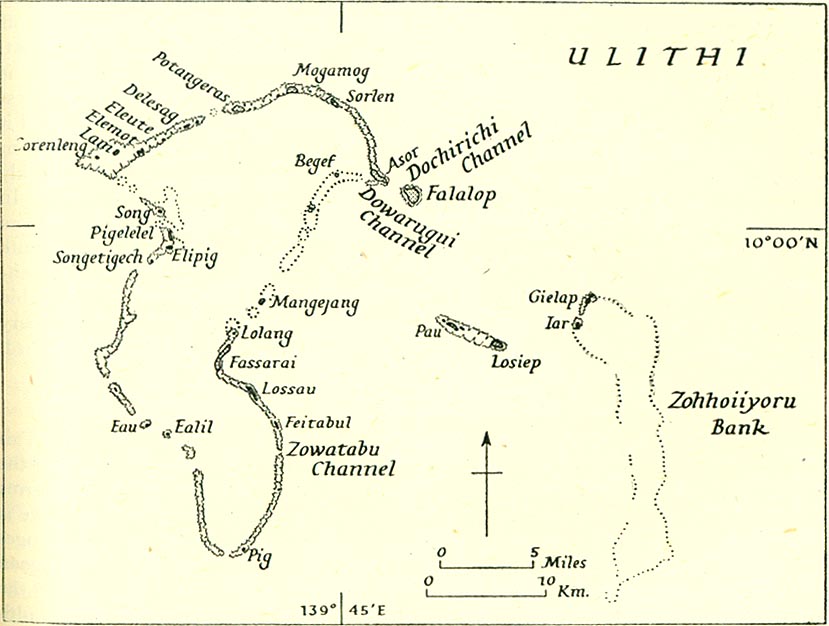
Located 360 miles southwest of Guam, 850 miles east of the Philippines, and 1,300 miles south of Tokyo, Ulithi was ideally situated to anchor the entire Third Fleet and to stage operations in the Western Pacific. The atoll was formed by a natural harbor, 19 miles in length and about 5 miles wide, surrounded by 40 tiny islands barely rising above sea level. The Japanese had established a radio and weather station at Ulithi and also anchored ships there early in the war. However, by September 23rd, as part of Operation Stalemate to take Peleliu2 and the Caroline Islands, the American invasion forces took the Ulithi without enemy ground opposition. By the 25th, the harbor was completely occupied.

Southwest Pacific


Some mopping up operations were still underway when Hector arrived at Ulithi on the morning of October 5th. The lagoon had just been swept of mines, and there were no port facilities for repairing or resupplying ships. As it reached Mugai Channel, Hector was met by the minesweeper, YMS-177, who directed her to berth 39 within the lagoon.

The remainder of Service Squadron 10 and all its equipment for the new base followed in 4 convoys, the first leaving Eniwetok on October 4th. Remarkably, no personnel or equipment was lost in the immense transport of Squadron 10 from Eniwetok. And nearly as remarkable was the fact that the enemy allowed the transfer to take place unopposed.

Ulithi Atoll
Source: Univ. of Texas Perry-CastaƱeda Library Map Collection

The task confronting the service squadron at Ulithi in October was to convert its lagoon into a major naval resupply and staging area. Within a month of the occupation of Ulithi, the Navy had constructed a floating, operational base—a vast network of pontoon piers, floating drydocks, and repair yards. It was an astonishing engineering feat.

Ulithi Atoll, late 1944. Foreground is one of several depot islands surrounding
the anchorage (from U.S. Navy photo from NARA collection)

Source: Mighty 90: Official Website of USS Astoria

Ulithi offered a huge capacity for anchorage for the ships of the fleet. It was larger than either the bases at Majuro or Pearl Harbor. Up to 700 ships could anchor within the lagoon at a time, creating the largest naval base in the world. And, with a base there to refit, repair, and resupply, many ships were able to deploy and operate in the Western Pacific for a year or more without having to return thousands of miles to a major base facility like Pearl Harbor or San Francisco.

1 Other repair vessels would eventually arrive at Ulithi and share in the daunting task of servicing and repairing the fleet's ships, equipment, and shore facilities. These repair vessels included sister repair ships Ajax and Vulcan, the heavy-hull repair ship Jason, internal combustion engine repair ships Mindanao and Tutuila, and several floating dry-docks.
2 On September 15, 1944, the U.S. 1st Marine Division landed on the beaches of Peleliu, one of the Palau Islands, 400 miles to the southwest of Ulithi. The amphibious assault was part of a larger operation to provide support for Gen. Douglas MacArthur's planned invasion of the Philippines. At Peleliu, the Japanese introduced a new tactic of fighting, which would be used again in prolonging the fighting on Iwo Jima and Okinawa. Rather than meeting the U.S. invaders on the beach, the defenders' main line of resistance was located well in the rear. While a token defense was offered at the beaches, the main force utilized interconnected caves and rugged terrain from which to mount a series of counterattacks. The island was declared secured on the 27th. The cost in American lives proved historic: Over 9,000 were killed or wounded by the time the invasion was over. The Japanese lost nearly 11,000 in killed and captured. The high casualty rate for the Americans exceeded all other amphibious operations during the Pacific War. Peleliu was never used in significant operations against Japan. Instead, Ulithi become the major staging base for operations in the Philippines and the invasion of Okinawa.

Sources: USS Hector War Diary, September & October 1944; USS Whitman War Diary, September & October 1944; USS Hector AR7- Ship's Log (WWII); Wikipedia; Mighty 90: Official Website of USS Astoria; The Two-Ocean War, Samuel Eliot Morrison,  Beans, Bullets and Black Oil, Chapter 18: "Further Stalemate Support," Worrall Reed Carter

Wednesday, August 13, 2014

Repairs to the carrier USS Hornet

The repair ships of WWII were fully equipped to address almost every kind of damage or make nearly every other kind of repair that a vessel might need. In the Pacific, these unique ships, stationed at advanced bases in combat zones, provided maintenance and support to warships of all kinds including landing craft, destroyers, submarines, seaplanes, battleships, and aircraft carriers. My dad, Frank Dolan, who had previously served on another repair ship, the USS Vestal, was also a weldor on the repair ship Hector, now stationed at Eniwetok.

On today's date in 1944, the aircraft carrier, USS Hornet (CV-12),* received catapult repairs from Hector's crews at Eniwetok in the Marshall Islands. Hector had to complete significant work on the ram and piston in order to put the catapult in operation. As a weldor, Dad probably would not have worked on this project, but it does illustrate the varied tasks that confronted a repair ship like Hector.


USS Hornet, October  27,1945
Source: Wikipedia Commons

The USS Hornet was commissioned in November 1943, and it quickly played a major part in the war in the Pacific. She spent weeks providing intensive air strikes in the Marianas Islands, including Saipan, Guam, and Tinian. On June 19, 1944, she participated in the decisive Naval Battle of the Philippine Sea. Her fighter pilots sank the Japanese carrier Shokaku and damaged another carrier and cruiser. They also shot down 52 Japanese planes in the famed "Marianas Turkey Shoot."

That same year, from its base at Eniwetok, Hornet attacked the enemy from Guam to the Bonin Islands south of Japan. Then it was on to the Palaus, the Philippine Sea, and to enemy bases on Okinawa and Formosa. Hornet's aircraft supported the invasion force at the Battle of Leyte, October 20. During the Naval Battle for Leyte Gulf, October 23-26, she launched raids against the Japanese in the Battle off Samar, the center-most action in the Battle of Leyte and hastened the retreat of the Japanese fleet.

Through the remainder of 1944, Hornet attacked enemy shipping and airfields throughout the Philippines, including participating in a raid that destroyed an entire Japanese convoy in Ormoc Bay. On December 30, 1944, she departed Ulithi in the Carolines for raids against Formosa, Indochina, and the Pescadores Islands. 

In 1945 Hornet left Ulithi for full-scale aerial assaults on Tokyo, then supported the amphibious landing on Iwo Jima, February 19-20. Her planes next supported the amphibious assault on Okinawa on April 1. A few days later, her fighters joined in attacks which sank the Japanese battleship Yamato near Okinawa. For another couple of months, Hornet provided support to ground troops on Okinawa and raided the industrial capacity of Japan. In almost continuous action for 16 months, Hornet was never hit by enemy fire. But from June 4-5, 1945, the carrier was caught in a typhoon, which collapsed a large section of her forward flight deck. She was forced to return to the states for major repairs. She was returned to service in September 1945, in time to bring home victorious American troops.

USS Hornet. Collapsed flight deck, June 1944
Source: NavSource.com

Unlike many of her sister warships, Hornet saw lengthy service after WWII. She next served in the Korean War and then Vietnam. She also had a role in the Apollo space program recovering manned and unmanned spaceships. In 1969, she recovered the Apollo 11 astronauts after their return from the first moon landing, and then she recovered the crew of Apollo 12 later that year.

Hornet was decommissioned in June 1970 and finally struck from the naval register in 1989. In contrast to so many other WWII warships, Hornet was spared scrapping, and in 1991 was designated a National Historic Landmark. She is now preserved as the USS Hornet Museum in Alameda, California.

For her extraordinary WWII combat record, USS Hornet earned 9 battle stars.

*The previous ship of this name was the USS Hornet (CV-8), the carrier that launched the B-25s in the Doolittle Raid over Japan in April 1942. It was destroyed in the Battle of the Santa Cruz Islands, October 1942.


Monday, June 30, 2014

Repairs to battleship USS California

Two and a half years after she was badly damaged and sunk by Japanese torpedoes and bombs at Pearl Harbor, the rebuilt battleship USS California reentered combat in the Pacific. One of her early tasks was to provide heavy gunfire support for the invasions of Saipan, Guam, and Tinian during June and July 1944.

On June 14, while California was bombarding Saipan, she was hit by a shell from a Japanese shore battery, killing 1 man and wounded 9. On today's date in 1944, the ship finished making her way to Eniwetok where she was received alongside my dad's ship, USS Hector, for repairs to her damaged guns. The barrels were replaced by spares from Hector and all other damage was restored by July 3. Back into action, those same guns helped clear the way for the assaults on Guam and Tinian from July 18 to August 9.

In October and November of that year, California took part in the Leyte Campaign, including the October 25th Battle of Surigao Strait, history's last fight between opposing battleships. In January 1945, California participated in the Invasion of Lingayen Gulf in the Philippines. Damaged by a kamikaze attack on January 6, she remained in action for more than 2 weeks before returning to the states for repairs and an overhaul.

California returned to the Western Pacific in June 1945, in time to take part in the final stages of the Okinawa Campaign. She covered occupation activities in the wake of Japan's surrender, then sailed for Philadelphia in December 1945. The USS California was decommissioned in February 1947 and sold for scrap in 1959.

USS California, 1945
Source: reocities.com

Launched in 1919, this venerable flagship of the Pacific earned 7 battle stars for her World War II service.

Sources: Naval Historical Center; USS California War Diary June & July 1944

Monday, June 23, 2014

Emergency repairs to USS Saranac

On today's date in 1944, the fleet oiler, USS Saranac, was received alongside my dad's repair ship, USS Hector, at Eniwetok for emergency battle damage work.

Saranac had been refueling carriers 30 miles east of Saipan when on June 18th, she and 2 other oilers in her group were attacked by Japanese aircraft. Saranac was hit by a bomb in her after superstructure deck, and her sick bay and engine room also were badly damaged. Tragically, 9 men were lost and 21 were wounded. The next day the stricken ship limped under her own power toward Eniwetok, all the while under enemy observation.

Crews from Hector worked in double shifts fully intending to complete Saranac's repairs. However, after the repair work was well underway, the Saranac received orders to return to the states for permanent repairs. Hector's crews then turned their attention to repairing the ship's power plant, enabling her to sail under her own power on July 2nd.

USS Saranac, near Mare Island, June 20, 1944
Source: Shipscribe.com

After her stateside repairs, Saranac rejoined the war in the Pacific. She supported the naval action in the Battle of Leyte starting in October 1944, the invasion of Okinawa in April 1945, and through the end of that year she refueled ships in the South China Sea. At the end of the war, Saranac was converted to a floating power barge for military installations in the Pacific. Finally, she was struck from the Naval Vessel Register in 1956, and a year later was sold to a private corporation.

For her distinguished World War II service the USS Saranac received 5 battle stars.

Sources: USS Hector AR7- Ship’s Log (WWII); USS Saranac War Diary, June & July 1944

Thursday, June 5, 2014

Underway for Eniwetok | Service Squadron Ten


On today's date in 1944, the day before the Allied invasion of Normandy, my Dad, Frank Dolan, was sailing from Pearl Harbor. Resupplied and with a fresh coat of camouflage paint, Dad's ship, USS Hector, sailed with a task unit of 4 other ships* for Eniwetok, codenamed "Babacoote." It was on its way to join its mobile service squadron, transferring there from Majuro. Crossing the International Dateline on the 9th, Hector arrived safely at Eniwetok Harbor on the 13th, reporting to the recently commissioned Service Squadron 10 of Task Force 38.

Navy service squadrons—composed of repair ships, floating drydocks, and other floating equipment—supported fleet combat units in the Pacific. During the war they allowed the Navy to operate across the ocean for extended periods of time. Service Squadron 10 (ServRon 10) provided for major naval bases relatively near the Navy's ongoing operations against the Japanese. The Squadron's vital work allowed ships to remain on duty for a year or more without the need to return to a major repair base stateside.

Eniwetok had been in Allied hands since their victorious invasion in February. The atoll now offered the Americans a strategic airfield and harbor from which to launch attacks on Japanese strongholds in the Mariana Islands further north. As a major forward operating base for the Navy and the Marines, there was a lot of work for a repair ship like Hector. Already, hundreds of Allied ships were anchored in the lagoon when Hector arrived. Many of these would be participating in the invasion of Saipan within a couple of days. At its peak in July, more than 520 ships were present in the lagoon.

Marianas Invasion Force assembled in the lagoon at Eniwetok Atoll, June 1944

For 3 1/2 months, Hector supported Task Force 38, the main striking force of the United States Navy through the latter half of the Pacific War. During that time, she repaired numerous ships alongside and in the harbor. Then, September 30th, Hector sailed for Ulithi.

Service Squadron 10 was commissioned at Pearl Harbor on January 15, 1944. It was based first at Majuro (February-May 1944), then Eniwetok (June-September 1944), Ulithi (October 1944-April 1945), and Leyte-Samar, P.I. (May-August 1945). At the height of its activities, the squadron controlled 609 vessels at 5 fleet anchorages.

Service Squadron 10 was designed to be a mobile base, furnishing logistic support, including general stores, provisions, fuel, ammunition, maintenance, repair, salvage, and such other services as required in the support of an advanced major fleet anchorage in the Central Pacific Area. It was directed to furnish similar logistic support to Navy and Marine shore-based units not otherwise provided for in the area. And, wherever possible, it provided services and supplies vital to any of our allied armed forces.

In addition to the Hector, an arresting array of additional repair ships and tenders also were present at Eniwetok. These included the repair ship Ajax; destroyer tenders Piedmont, Cascade, and Markab; repair ship landing craft Egeria; floating drydocks ARD-13 and ARD-15; mobile floating drydock AFD-15; and floating workshop YR-30.

At Eniwetok, before leaving for Ulithi, Hector's welding shop crew posed
for this photograph. Metalsmith, 1st Class Frank Dolan is center, second row.

*Task Unit 17.7.12, was comprised of USS Hector, escort aircraft carriers USS Natoma Bay and Manila Bay, and the destroyers USS Halligan and Haraden.

Sources: USS Hector War Diary, June 1944; Beans, Bullets and Black Oil, Chapter 10: "Service Squadron Ten Organizing at Pearl," Worrall Reed Carter

Thursday, April 3, 2014

Hector sets sail for Pearl Harbor

On today's date in 1944, the recently commissioned repair ship, USS Hector, finally gets underway for Pearl Harbor and action in the Pacific. My dad, Frank Dolan, having served on the USS Vestal in the Pacific Fleet since 1941, is a metalsmith on this newest of the fleet repair vessels. Compared to conditions on his old ship, he remembered the accommodations on Hector as almost luxurious.

This will be Dad's second trip to the Hawaiian Islands. He was there serving on the USS Vestal in 1941, when he witnessed firsthand the Japanese attack on Pearl Harbor, December 7, 1941. His ship, though seriously damaged herself, was instrumental in repairing many of the other ships and installations damaged in that attack.

Now passing through California's Channel Islands on this day in 1944, Hector began its zig-zagging course across the Pacific Ocean, arriving at Pearl Harbor on April 9th. It will stay there for several weeks repairing various vessels, primarily LSTs and other amphibious assault ships needed for amphibious landings in "Operation Forager," the June campaign for the Mariana and Palau Islands. 

Hector will remain at Pearl until departing on June 5th for the forward naval base at Eniwetok.


Sources: Frank L. Dolan Service Records; USS Hector War Diary, April 1944; USS Hector AR7- Ship’s Log (WWII); Dictionary of American Naval Fighting Ships; 

Monday, February 17, 2014

The Battle of Eniwetok, 1944

Part of America's "island hopping" strategy in the Pacific was the invasion of Eniwetok* Atoll in the Marshall Islands. That attack, known as "Operation Catchpole," began on this date in 1944. It occurred during a simultaneous operation against the Japanese naval and air base at Truk Atoll, 670 miles southwest, on the 16th-17th.

Following up on the success in the Battle of Kwajalein, the Americans set their sights on an airfield and harbor from which to launch attacks on Japanese strongholds in the Mariana Islands further north. The capture of the Eniwetok atoll would provide just what the Allies needed.

Like the other atolls in the Marshall Islands, Eniwetok was a harbor surrounded by tiny coral and sand islands. The circumference of the 30-island ring is 64 miles, with a maximum elevation of only 15 feet above sea level. Three entrances provided passage in and out of the lagoon.

Source: Stamford Historical Society, Inc.

The naval bombardment began on the February 17th. The next day, Marines landed on Engebi Island, the larger of the northern islands, taking it in only 6 hours. On the 19th, Army infantry landed on Eniwetok Island in the south. Fighting there was more difficult, and the island was not secured until the 21st. On the 22nd, Marines took neighboring Parry Island. By the following day, the remaining islands were also under American control. In total, the atoll was secured at a cost of 339 Americans killed and missing, and 2,677 Japanese.

Marine assault waves on the well-bombed Engebi Island, February 18, 1944
Source: US Military Challenge

With the capture of Eniwetok Atoll control of the Marshall Islands, which had been in Japanese hands since 1914, passed to the United States. Eniwetok immediately became a major forward operating base for the Navy and an airbase for the Marines. In June 1944, my dad, Frank Dolan, will arrive on his newly commissioned repair ship, USS Hector, to begin 3 1/2 months of repair jobs. Nearly 500 Allied ships could be seen present in the lagoon when Hector arrived.

* In 1974 the official spelling was changed to "Enewetak."

Sources: Frank L. Dolan's Service Records; The Two-Ocean War, Samuel Eliot Morison

Sunday, February 16, 2014

The Battle of Truk, 1944

The Battle of Truk* ("Operation Hailstone"), fought on February 16-17, 1944, was a massive U.S. naval air and ship attack on a major part of the Japanese fleet in the South Pacific.

Truk, a South Pacific atoll in the Caroline Islands, was a significant logistical base for the Japanese fleet. The atoll was the only major Japanese airbase within range of the Marshall Islands, offering support for enemy garrisons located there and on islands throughout the central and South Pacific. Gaining Allied naval and air superiority was vital if planned operations against other enemy island defenses were to be successful.

In fact, crippling the Japanese support from Truk was essential for a successful invasion of Eniwetok, 670 miles northeast, which was occurring almost simultaneously.

Battle of Truk Atoll, February 16-18, 1944
Source: National Archives
For 2 days, the U.S. directed airstrikes, surface ship bombardments, and submarine attacks against Japanese airfields, aircraft, and shore installations on the atoll, as well as against ships in and around Truk's lagoon.

The U.S. scored a major victory at Truk. Historian Samuel Eliot Morison calls the raid one of the most successful in the war. The Americans sank numerous naval and merchant ships. They also destroyed over 250 Japanese planes. Thirty-two American planes were lost and 2 ships were damaged.

The success at Truk essentially ended it as a major threat to Allied operations in the Central Pacific. The Japanese garrison on Eniwetok was denied reinforcement and support during the invasion that began on February 18, allowing the U.S. to capture that stronghold without threat of a single enemy plane.

Battle of Truk Atoll, February 16-18, 1944
Source: National Archives

*After the war, the name was changed to "Chuuk" in most western countries, a more accurate spelling for the local name for the island.

Source: The Two-Ocean War, Samuel Eliot Morison

Wednesday, January 29, 2014

The Battle of Kwajalein, 1944


While my dad, Frank Dolan, completed his training in San Diego for duty on the new repair ship, USS Hector, the war against Japan continued in the Pacific. In November of 1943, the U.S. and its Allies drove Japanese occupiers from Makin and Tarawa in the Gilbert Islands. The Americans' next objective was the Marshall Island chain. The Battle of Kwajalein, the opening of Marshall Islands Campaign, was fought from January 29 to February 3, 1944.

A small group of 29 atolls and 5 islands in the Northern Pacific settled by ancient Micronesian peoples, the Marshalls were under Japan's control into the Second World War. The islands, located about 2,900 miles east of Japan, formed a key part of the Empire's outer perimeter defense. The location of the islands also made them offensively strategic for the Japanese Navy.

By this point in the war, the Japanese were withdrawing from advanced positions in the Pacific, choosing to defend their nation closer to home. Their strategy for the island chain was to use its defense as a delay action while establishing a new defensive perimeter closer to Japan. They fortified garrisons on the eastern and southern perimeter islands, which were most exposed to attack by the Americans.

The American plan for taking the Marshall Islands, known as "Operation Flintlock," called for hopping over the fortified outer islands and directly attacking Kwajalein, the world's largest coral atoll, and center of Japanese control over the islands.

Source: World War II Database

U.S. aircraft carriers began their air offensive against Kwajalein on today's date in 1944. On January 31, U.S. Marines landed on Majuro Atoll and took it without any casualties, preparing it as a forward base for the full invasion. After overwhelming air and naval bombardment, Kwajalein was stormed by Marines and Army troops on February 1, and declared secured on the 7th, with a loss of only 372 Marines and soldiers killed. In contrast, the Japanese death toll was 7,800. On February 12th, Marines landed on Arno Atoll and began a series of mopping-up operations in the remaining minor atolls of the Marshall Islands.

The capture of Kwajalein allowed the Navy high command to step up its operations in the Marshalls and invade the important Eniwetok Atoll on February 17, 1944. In early April, Dad will sail with the Hector on its maiden voyage to Hawaii. By June, Hector will be repairing ships at the new forward naval base at Eniwetok.

Sources: Frank L. Dolan's Service Records; The Two-Ocean War, Samuel Eliot Morison; World War II Database; 

Wednesday, November 13, 2013

Gilbert Islands Campaign, 1943

On this date in 1943, while my dad, Frank Dolan, was en route to the states after 2 years of Pacific service on the USS Vestal, the U.S. Navy began its invasion of the Gilbert Islands, codenamed "Operation Galvanic." Just days before, Dad's troop transport ship, Matsonia, made a 1-day stop at Funifuti, on the southern tip of this long, Pacific island chain. The next day, Matsonia, continued its voyage on to San Francisco, arriving there on November 17th, just as the amphibious invasion of the Gilberts was about to commence.

The Gilbert Islands, together with the Marshalls to the north, were strategic for the success of the Americans in their naval and marine operations against the Japanese Imperial Navy. Their goal was to establish airfields to provide air support for the upcoming operations across the Central Pacific. The first step was to gain control of strategic positions in the Gilbert Islands as the Allies penetrated Japan's eastern defensive perimeter.

Two atolls were key to the American invasion: Makin and Tarawa. Within days after their attack on Pearl Harbor, the Japanese occupied the Gilberts. They built a seaplane base on Makin and dispersed troops along the coastlines of the atolls to monitor the movement of Allied forces in the South Pacific. The largest and most strategically important atoll was Tarawa where a Japanese airfield was located on the tiny island of Betio. Of the two, Tarawa was the most heavily fortified, and it would prove the most difficult and costly for the U.S. Marines who would have to take it.

Source: World War II Database

The battle for Makin began on today's date in 1943, with Army and Navy air attacks. That was followed on the 20th by an Army infantry landing on mostly undefended beaches. They pressed inland over the next couple of days and defeated the Japanese stronghold. The Americans lost 66, with 152 wounded, while 395 Japanese defenders were killed.

Taking Tarawa to the south was not so easy for the Marines. The Tarawa atoll was comprised of 38 islands surrounded by coral reef. Taking the important airfield on Betio was the primary goal. The invasion was preceded by a naval bombardment, which as it happened, was not nearly sufficient to destroy or soften up enemy defenses. Then on the morning of the 20th, Marines boarded their amphibious landing craft and headed for the Betio Island beach. Soon, though, their crafts became stranded on the reef, and the men were forced to wade 700 yards to the beach under horrendous enemy fire. While they took heavy casualties, the Marines reached the beach. However, they were pinned down until on the 21st they were able to pierce the defensive line and eventually take the island. Over the next several days, the Marines took the smaller islands around the atoll. By the end of the Battle of Tarawa, there were more than 1,000 Americans killed and 2,200 wounded. 4,690 of the enemy were killed.

Of course, news of the opening of the Gilbert Islands Campaign had hardly reached the states when Dad arrived there on November 17th. Over the next several months, Dad's new repair ship, USS Hector, will complete its final shakedown before beginning operations in the Pacific Theater. The naval campaign against Japan will proceed next with the invasion and occupation of the Marshall Islands. Within a few months, Dad will be on the Hector, stationed on the remote forward naval base of Eniwetok in the northern chain of these newly captured islands.

Sources: Frank L. Dolan's Service Records; The Two-Ocean War, Samuel Eliot Morison; World War II Database

Followers