Showing posts with label Ulithi. Show all posts

Monday, March 30, 2015

21 days at Ulithi

During much of February and March 1945, my dad, Frank Dolan, serving aboard repair ship, USS Hector in San Pedro Harbor in the Leyte Gulf, assisted in repairing ships for ongoing naval operations in the campaign for the Liberation of the Philippines. Hector remained there on duty until March 27th, when she was ordered back to Ulithi. Escorted by the Australian frigate, HMAS Gascoyne,* Hector arrived at the atoll on today's date, 1945. The next morning the ship was assigned to anchorage in the northern part of the lagoon.

For 21 days in April, Hector's crews performed various repairs to ships assigned to Service Squadron 10. Hector's services next were required for supporting the naval forces in the Okinawa Campaign. So on April 21st, she was ordered to Saipan in the Mariana Islands.

* The HMAS Gascoyne was one of the ships honored to be present in Tokyo Bay for the formal Japanese surrender ceremony on September 2, 1945. She also received 5 battle honours for her WWII service.

Sources: USS Hector War Diary, March & April 1945

Thursday, February 19, 2015

USS Hector arrives in the Philippines, 1945

For several months in 1944-1945, my dad, Frank Dolan, was stationed on his repair ship, USS Hector, at Ulithi in the Western Caroline Islands. As part of Service Squadron 10, which had converted the lagoon there into a major naval facility, Dad's ship next was ordered to the Philippines. The progress of American forces closer toward victory throughout the Philippine Islands required advancing support elements, like repair ships, into closer proximity to the fighting afloat and ashore.

Hector sailed from Ulithi on February 16th, as part of Task Unit 50.9.6, escorted by the destroyers Bancroft and Bailey. Also joining this task unit were the attack cargo ship Fomalhaut, destroyer tenders Dixie and Markab, and repair ship Prometheus.1 The task unit was the vanguard of Service Squadron 10, of which the main force would follow in May.

On today's date in 1945, Hector arrived with Task Unit 50.9.6 at her new location in San Pedro Harbor, off Tarragona, in the northwest end of Leyte Gulf near where the Leyte Landings occurred the previous October. While the Battle for Manila raged nearby to the north, Hector's crews began repairing ships and readying other craft for continued operations against the Japanese occupiers.2

Hector remained on duty in Leyte Gulf until the end of March, when she returned to Ulithi for 21 days. Then in late April, Hector was shifted to Saipan in the Mariana Islands, while the main body of Service Squadron 10 was moved to San Pedro Harbor.

For his role in the Philippines Campaign from February through March, Dad received the Philippine Liberation Campaign Ribbon.


1Prometheus was the sister ship to Dad's previous repair ship, USS Vestal.
2Also on today's date in 1945, American Marines began their assault on Iwo Jima, preceded by 5 days of naval and air bombardment. Dreadful fighting there will last for 5 weeks.

Sources: Dictionary of American Naval Fighting Ships; USS Hector and USS Prometheus War Diaries, February & March 1945

Monday, January 26, 2015

Repairs to battle damaged USS Langley


On today's date in 1945, my dad's ship, the USS Hector, stationed at Ulithi Atoll, received the carrier USS Langley alongside for battle damage repairs. The ship had been participating in the 3rd Fleet's daring raid into the South China Sea when off Formosa it was bombed by a Japanese fighter.

Part of the fleet's Task Force 38 (TF 38), Langley was helping to provide cover and support for the Philippine Campaign through air strikes over Formosa, Luzon, and the Visayas. She was also assisting TF 38 in destroying Japanese vessels which might threaten the landings on Luzon. From January 10-20, TF 38 went out in search of an enemy fleet that could menace the ongoing Battle of Luzon.

While TF 38 did not encounter any enemy warships, planes from its force sank 44 enemy ships, mostly merchant marine, with very few of its own planes lost. On January 21st, the carrier planes attacked Formosa, but here the Japanese used their kamikazes in striking back. USS Langley was hit, the bomb penetrating the forward flight deck and exploding in officers' staterooms. Furniture, bulkheads, piping, and deck were damaged or destroyed.*

USS Langley, March 1945, shortly after receiving repairs from USS Hector
Source: Navy Historical Center

In addition to the Langley, the carrier USS Ticonderoga and the destroyer USS Maddox were also damaged, along with 201 aircraft destroyed. In terms of human loss to the fleet, 167 pilots and air crewmen and 205 sailors were killed in the kamikaze attacks.

Langley remained alongside Hector for repairs through February 5th when she was returned to service with the Third Fleet continuing its carrier operations in the South China Sea against the Japanese Home Islands and the invasion of Iwo Jima. More combat activity followed in March through May, as Langley's planes again hit targets in Japan and supported the Okinawa operation. Back to the U.S. for overhaul and modernization in June and July, the carrier was returning to the Pacific combat zone when the war ended in August.

For a couple of months, Langley transported home veterans of the war in the Pacific. Then the ship sailed to the Atlantic where she carried out similar missions from November 1945 through January 1946. Following months of inactivity, Langley was decommissioned in Philadelphia in February 1947. In early 1951, the ship was refurbished and transferred to France under the Mutual Defense Assistance Program. After more than a decade of French Navy service under the name La Fayette, the valiant warship was returned to the United States in 1963, and sold for scrap a year later.

The USS Langley received 9 battle stars for her World War II service.

USS Langley leads a very impressive force returning to Ulithi in
December 1944, from strikes on targets in the Philippines.
Source: Naval Historical Center

*The Japanese plane from Formosa that hit the Langley likely carried a 200-pound bomb. The plane narrowly missed the flight deck and crashed into the sea. The pilot may have intended a suicide attack and just missed the deck; or it is possible that he tried to escape after releasing his bombs but ended up crashing after his plane was hit. In either case, the bomb killed 3 of Langley's crew and seriously wounded 11 others.

Sources: The Two-Ocean War, Samuel Eliot Morrison; USS Hector War Diary, January 1945; USS Hector AR7- Ship's Log (WWII); USS Langley War Diary, January & February 1945 and Action Report January 1945: Naval Historical Center

Monday, January 12, 2015

Second kaiten attack at Ulithi

Throughout the first couple of weeks of January 1945, my dad's repair ship, USS Hector, brought the subchaser, USS PC-1130, alongside for emergency repairs. The patrol craft's sonar equipment had been damaged and required Hector's attention. Even while receiving repairs, however, the ship still carried on patrol duties as required. One of the big concerns was the ever-present danger of another attack like the one on November 20, 1944. In that attack, Japanese submarines launched human torpedoes, or "kaitens," toward the anchored fleet, destroying USS Mississinewa and killing 60 of her crewmen.

Nearby, on today's date, the ammunition ship, USS Mazama, which had only days before arrived at Ulithi with a full load of cargo, sighted a suspicious moving object off its starboard side. Moments later, around 7:00 AM, an explosion rocked the ship, causing severe flooding. It had been attacked by a kaiten.

Around 9:00 AM, the PC-1130 was ordered underway from the Hector to patrol for enemy midget subs within the harbor. At 10:15, the subchaser witnessed an explosion about 200 yards away. Although its sonar was temporarily knocked out in the explosion, nevertheless the subchaser immediately altered course to intercept and ram the sub if it surfaced. As it passed over the spot, it dropped 3 depth charges for good measure. Leaving follow-up work for an arriving destroyer, the PC-1130 proceeded on outside the lagoon to continue its patrol.

Meanwhile, the damage and flooding on the Mazama had caused the ship to list. Immediately, pumping was started to handle the flooding. For a while, the crew thought the ship may have to be beached to avoid sinking, so it got underway for land. However, tugboats and other fleet vessels came to assist the struggling ship. A diving crew from Hector also arrived to inspect the damage and effect temporary repairs. Hector's divers confirmed that the explosion had indented a significant section of the ship, and its seams had separated. The next day, a repair party from Hector caulked and plugged the open seams enough to pump out the water.

The Japanese submarine that had launched the attack against the Mazama was the I-36, the same ship that launched its manned torpedoes against Ulithi the previous November. This time, a Navy PBM patrol bomber spotted one of the attacking kaitens in the lagoon and destroyed it by dropping 4 depth charges. But the other 3 managed to attack targets within the harbor. In addition to damaging the Mazama, killing 1 and seriously injuring 7, another of the kaitens sank the infantry landing craft, LCI-600, killing 3.

Temporary repairs to the Mazama were completed by March 6 when the ship steamed for San Francisco for permanent repairs. By June, she was back in the Philippines with 5,000 tons of ammunition. In July, she entered San Pedro Bay where she remained through the end of the war. After participating in the American Occupational Force of the Japanese Home Islands, she enjoyed a long period of service until her permanent decommissioning in 1970. The USS Mazama received 5 battle stars for her WWII service.

PC-1130 also survived the war, and after spending some time in reserve, was transferred to France and then to South Vietnam. She was struck from the Naval Register in 1965.

The I-36 continued to see service in the Japanese fleet, surviving until the surrender in September 1945. On April 1, 1946, as part of "Operation Roads End," the I-36 was towed to sea and scuttled.

Sources: USS PC-1130 War Diary, January 1945; USS Mazama War Diary, January 1945

Monday, November 24, 2014

Repairs to USS Wintle

In November of 1944, crews from my dad's repair ship, Hector, performed some work on the destroyer escort, USS WintleWintle had developed evaporator and other mechanical problems while performing patrol and escort duties in the Palau Islands, and these issues needed attention.

Arriving at Ulithi on the 16th, Wintle was assigned to the destroyer tender USS Cascade,* but quickly learned that other ships rated a higher priority for service and repair. Some jobs that could be carried manually to the Cascade were tended to.

Finally on today's date in 1944—Thanksgiving Day in the Carolines—Wintle was taken into the drydock ARD-15Hector repaired her sonar equipment, while crews from the 3 ships mended the rudders and repainted the hull's bottom.

Wintle's repairs were completed by the 26th, and the next day she was back in service escorting a cargo ship to Guam.


USS Wintle

The USS Wintle was launched in February 1943. She safely escorted numerous oilers, cargo ships, and convoys, supported the Invasion of the Gilbert and Marshall Islands, performed search and rescue, and engaged in anti-submarine warfare. The ship served her entire career in war service in the Pacific. She was decommissioned in November 1945, and sold for scrap in 1947. The USS Wintle distinguished herself during the war by earning 3 battle stars.


*Within a month, the USS Cascade, will become the scene of a naval court of inquiry to investigate the loss of 3 ships and almost 800 men in Typhoon Cobra, which struck Admiral Halsey's Third Fleet in the Philippine Sea on December 18, 1944. Among other high ranking admirals, will be the commander of the Pacific Fleet, Admiral Chester A. Nimitz.

Sources: USS Wintle War Diary, November 1944; Destroyer Escort USS Wintle DE-25 Home Page; Wikipedia

Thursday, November 20, 2014

Human torpedo attack at Ulithi

Throughout the month of November in 1944, my dad's repair ship, USS Hector, continued its extensive repair work on USS Houston for combat damage received earlier in October. So far the work had been hampered by bad weather, the most serious of which was a typhoon that hit the area from November 6th to the 8th.

Back on the repair job early on today's date in 1944, Hector's crew heard a huge explosion and saw fire and billowing black smoke from another ship anchored in the lagoon. It was the fleet oiler, USS Mississinewa, just attacked by a human torpedo, a Japanese suicide mini-submarine called a "Kaiten."

Earlier that morning 2 enemy tender submarines near Ulithi, I-36 an I-47, launched 4 mini-subs toward the anchored fleet.* After the attack on the Mississinewa, U.S. destroyers began dropping depth charges throughout the anchorage. The Case rammed 1 in the early morning hours. At 6:25 the cruiser Mobile reported that a torpedo had passed under its bow. The destroyer escorts Rall, Halloran, and Weaver attacked and sank a mini-sub.

Source: Naval History and Heritage Command

The Hector's Log reported that it was in "Condition One" from the time of the attack until after 2 PM. The crew manned its guns, and boats were launched to patrol the water around the vessels. No contact was made, but sailors witnessed 2 underwater explosions in the atoll, which indicated the presence of additional torpedoes.

The sinking Mississinewa, November 20, 1944
She was the first ever victim of a Japanese human torpedo attack.
Source: National Archives

The explosion on the Mississinewa had ignited thousands of gallons of diesel and aviation fuel. Flames spread forward to the magazine, which caused a heavier explosion than the first. Nearby ships sent boats to rescue many of the men who escaped into the flaming waters, but after burning for several hours, the ship rolled over and sank to the bottom of the lagoon, taking 60 crewmen with her to her grave.


Kaiten Type 1
Source: Wikimedia Commons
* The Kaiten Type 1, was essentially a modified, 48-foot long torpedo, loaded with explosives, and controlled by a single man sealed inside. Once ensconced within, the pilot could not unlock the hatches. It was a 1-way mission.

Five of these suicide torpedoes were launched on Ulithi that morning from 2 subs lurking outside the lagoon. The I-47 launched her Kaitens, but none was successful in hitting a target. Three of the manned torpedoes on I-36 were unable to launch due to mechanical problems, but the remaining one successfully struck the Mississinewa with catastrophic results. This won't be the last time that the I-36 will launch a similar attack on Ulithi.

Sources: USS Hector AR7- Ship’s Log (WWII); USS Hector War Diary Nov 1944; Pacific Wrecks

Monday, October 27, 2014

Rescuing the USS Houston

By all accounts, the biggest repair job for my dad's ship, USS Hector, at Ulithi—or anywhere throughout the war—came on this date in 1944. The cruiser, USS Houston, twice torpedoed by Japanese bombers, was towed alongside for repairs. 

A couple of weeks earlier on October 14, USS Houston was attacked by Japanese torpedo planes off the coast of Formosa (known today as Taiwan), causing serious damage. Initially, the flooding was so severe that the crew was ordered to abandon ship. However, when further investigation showed that the ship might be saved, the commanding officer ordered all remaining personnel to stay on board. Two hours later the wounded Houston was under tow by the heavy cruiser, USS Boston.

For the next 2 days, the remaining skeleton crew pumped water, shored bulkheads, and fought fires while their ship continued to settle further in the water. They also found some time to burry 2 men who died of fatal burns from the torpedo attack. More burials would follow.

On the 16th, the tugboat Pawnee took over towing Houston to Ulithi for repairs. That afternoon a second aerial torpedo hit the ship, killing 55 crewmen and wounding many more. However, despite the terrible human loss and further damage to the ship, Houston's heroic crew fought to keep the ship afloat.2 The brave men of the Pawnee also never wavered in their task. Amazingly, both ships managed to make it to Ulithi on this date where the Hector was waiting.

The skeleton crew left aboard Houston managed to keep the stricken ship afloat
throughout its 14-day, 1250-mile tow to Ulithi. The first torpedo hit Houston amid-
ships on October 14th. The second struck the cruiser's starboard quarter while she
was under tow on October 16th.

Initially, Hector's crews spent a great deal of time and effort in clearing away wreckage, welding up holes, pumping out water, washing up oil and fuel, and otherwise readying the ship for extensive repairs. During this stage, there also was the grim task of removing bodies. The remains of 30 victims had to be recovered from the lower, flooded parts of the ship.

Dad was among welding crews completed myriad repair jobs, including the installation of more than 2,000 feet of T-bar to stiffen and reinforce the main, second, and upper decks. Houston's girders and plating were strengthened, and equipment was salvaged and repaired. Steering control to the bridge was also restored.

Hector's repair crews tended Houston from October 27 to December 14, 1944

Although interrupted by enemy sub attacks3 on ships in the harbor and hampered by a severe typhoon season,4 Hector managed to repair Houston by December 14, in addition to work on many other smaller vessels.

Houston next was towed to Manus Island for further repairs, and then headed back to New York Navy Yard in March 1945. Her permanent repairs were completed as the war drew to a close. Houston  remained in service until 1947, when she was decommissioned. In 1959, she was sold for scrap. 

The valiant USS Houston received 3 battle stars for her World War II service.

The resurrected Houston in January 1945, following emergency repairs by Hector

The cruiser, USS Birmingham, was another ship that came to Houston's aid after the attack. She acted as escort for the damaged ship and took on almost 200 crew members evacuated from Houston. Birmingham will again come to the aid of another critically damaged ship in the Battle of Leyte Gulf. However, tragically, on October 24th, Birmingham suffered extensive damage in the rescue attempt, and received 200 casualties among her crew.
Houston's War Diary for October 1944 is fascinating for its detail and description of the 14-day ordeal on the stricken ship.
On November 20, 1944, the Ulithi harbor was attacked by Japanese human torpedoes (kaitens) launched from 2 nearby submarines. The fleet oiler, Mississinewa, was struck and sunk. Guns were manned, and boats from Houston and Hector patrolled the water around these vessels. No contact was made, but sailors witnessed 2 underwater explosions in the atoll.
On November 5, Hector towed Houston to the southern part of the harbor near Pig Island for shallow water anchorage during the typhoon that hit from the 6th to the 8th. Wind and rough water caused additional damage to the ship. Houston remained there through the end of the month.

Sources: USS Houston War Diary, October-December 1944; USS Hector War Diary, October-December, 1944; USS Hector AR7- Ship’s Log (WWII)Dictionary of American Naval Fighting Ships; Naval Historical Center

Wednesday, October 15, 2014

Liberty on Mog Mog

Within a few days after the Ulithi Atoll in the Caroline Islands was taken on September 20, 1944, advanced portions of the Navy's mobile service force, Service Squadron 10, began arriving to create an expansive anchorage for the fleet. My father's repair ship Hector, was one of the first ships of the squadron to arrive and begin initial work in the lagoon.

A few days later, a naval construction battalion of "Seabees" arrived to construct an airstrip on Falalop Island. The Seabees also went to work completing a number of uniquely designed pontoon piers, instantly increasing the harbor's function and capacity.

Within days, 6,000 ship fitters, artificers, weldors, carpenters, electricians, and other servicemen of Service Squadron 10 arrived aboard repair ships, destroyer tenders, and floating dry docks. Together they transformed Ulithi into the largest naval base in the world. It was an incredible feat.

Sailors arrive at Mog Mog Landing
In additional to other engineering and construction projects, crews also built a much-needed fleet recreation facility for Sailors and Marines who had been fighting and working nearly non-stop for months.

The tiny 60-acre island of Mog Mog was selected for the facility. It was at first an unsuitable area, swampy and mosquito- and insect-infested. But the swamp soon was cleared and filled in with coral, creating a spacious recreation area.

Construction began on this date in 1944. Several venues for sports, a bandstand, and beverage storage were provided. When completed in January 1945, the center could accommodate 8,000 men and 1,000 officers daily. A 1,200-seat theater, including a 25-by-40-foot stage with a Quonset hut roof was also created, along with a 500-seat chapel.

The intersection of "Hollywood and Vine,"
near the landing area at Mog Mog
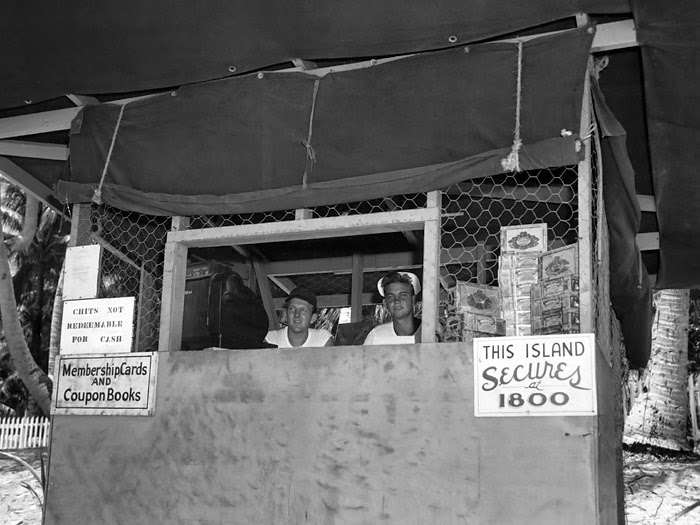
Refreshment Stand on Mog Mog Island 
Beach Liberty


For several months in 1944-1945, Mog Mog would have been the only land that most sailors of the Pacific Fleet would have set foot on. As ships returned to Ulithi for replenishment, crewman were allowed a few hours ashore. Landing craft picked up the men from their ships anchored in the harbor, dropped them off for an afternoon ashore, then returned them to their vessels by early evening.

Friday, October 10, 2014

Ship repairs after the October storm, 1944

One of the early projects that the USS Hector tackled at Ulithi was the salvaging of the Landing Craft Tank, LCT-1052. My dad, Frank Dolan, who was a weldor and certified diver on Hector, likely would have participated in recovering and restoring this vessel, which work was begun on this date in 1944.

The lagoon at Ulithi Atoll provided a natural harbor, which was soon to become home to over 600 ships. The northern and southern ends of the lagoon offered the smoothest water for anchorage. However, the lagoon had a serious drawback: It could not provide adequate shelter in stormy weather. The 40 islands surrounding it were barely above sea level, and they offered only slight protection from high winds.

USS LCT-1290, sister ship to LST-1052, beached at Ulithi
in 1944, and repaired by Hector
Source: Navsourc.com
October was the middle of typhoon season in this part of the Pacific. On the morning of Tuesday, October 3, 1944, word came of an impending typhoon passing about 150 miles north of Ulithi. That evening Ulithi's lagoon was hit by 8-12 foot waves, which were enough to drown the engines of the LCT-1052, causing her to drift and then to sink. Her 14 crew members were rescued, but tragically her commanding officer was lost. Another LCT (LCT-1290) and several LCMs (Landing Craft Mechanized) were also damaged by the storm.*

A week later on today's date in 1944, Hector went to work salvaging the LCT-1052. Hector's diving squad patched leaks, sealed tanks, and by using compressed air was able to float the vessel enough to be towed. By attaching Hector's anchor chain to the LCT's stern, she was able to raise the LCT to a point where, with assistance from the USS Enoree, it was brought alongside and hoisted clear of the water. Hector's crews then went to work making the LCT-1052 watertight. Finally, they repaired and replaced all equipment, putting the vessel back into operation by December 7.

The bow of USS LCT-1052, victim of a typhoon near Ulithi, October 3, 1944,
recovered by USS Hector and returned to operation in December.
Source: NavSource.org

Of course, this extensive repair job was just one of many for Hector during October. The largest, by far, was the work done on the battle damaged cruiser, USS Houston, which was started on the 27th.

*According to Hector's War Diary for October, "Salvaged LCTs 1052, 1290 and several LCMs which had been stranded in recent storm.”

Sources: USS Hector AR7- Ship’s Log (WWII); USS Hector War Diary, October 1944; USS Aldebaran War Diary, October 1944

Sunday, October 5, 2014

Avoiding the censors at Ulithi

There was a lot of secrecy surrounding the U.S. Navy's forward operating base at Ulithi in the Western Carolines, and for good reason. By October 1944, it will grow into the hub for U.S. Navy operations in the Western Pacific, including key combat operations at Leyte and Okinawa. It will maintain that role for 8 months until the liberated Philippines replaces it as the new forward staging area. At its peak, during the staging for the invasion of Okinawa in May 1945, Ulithi will be home to 722 American and Allied ships.

In order to avoid betraying a ship's destination at Ulithi and other advanced bases by her mail cargo, numbers were assigned by Navy and Marine Corps. Mail going to Ulithi was designated "Navy 3011." And, for added security, return mail home was heavily censored.

Frank Dolan, Ulithi 1944
My dad, Frank Dolan, assigned to the USS Hector, always tried to write his family back home about where he was stationed and what he was up to. But the heightened secrecy about Ulithi meant that letters had to be cleverly written to avoid the censor's cut. When Dad wrote to his sister, Flora, he used a prearranged code. They had agreed that he would disguise his location in the second paragraph of his letters. He buried the name "Ulithi" in the first letter of each of the first 6 syllables: “Un-less I tell her I’m OK Mom will worry about me.” The message got through, although apparently in 1944, it was nearly impossible for the family in California to find a world map that included the location of the tiny atoll.


Source: Frank L. Dolan's personal remembrances

Tuesday, September 30, 2014

Sailing for Ulithi, 1944

During the summer of 1944, my dad, Frank Dolan, was stationed aboard the USS Hector at Eniwetok Atoll, only recently captured from the Japanese. While there, crews from Hector repaired numerous ships both alongside and docked throughout the harbor.

By late September, Hector's services were needed at the new forward naval base at Ulithi Atoll for support of Task Force 38, the fleet's main striking force in the latter half of the Pacific War. The rest of the Navy's mobile service force, Service Squadron 10, would follow in the days ahead.1

On today's date in 1944, Hector and destroyer USS Whitman, forming Task Unit 57.4.8, steamed on a zig-zagging course for the small atoll in the Western Caroline Islands. For part of the nearly 1,400-mile trip the ships had to endure extremely heavy seas and wind, which caused some damage to equipment aboard Whitman. The fierce weather was a harbinger of an unusually violent typhoon season ahead. Repairing Whitman's damage became Hector's first job upon arrival at Ulithi.

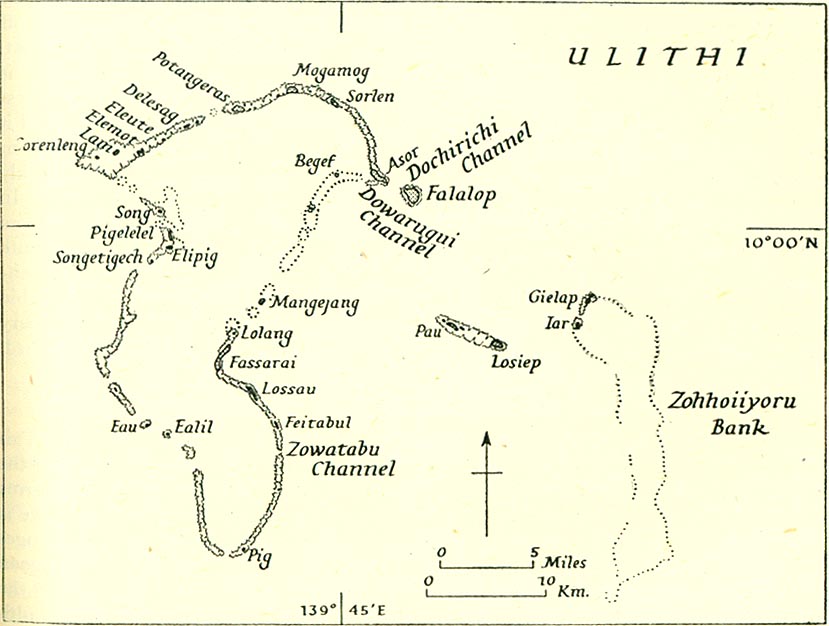
Located 360 miles southwest of Guam, 850 miles east of the Philippines, and 1,300 miles south of Tokyo, Ulithi was ideally situated to anchor the entire Third Fleet and to stage operations in the Western Pacific. The atoll was formed by a natural harbor, 19 miles in length and about 5 miles wide, surrounded by 40 tiny islands barely rising above sea level. The Japanese had established a radio and weather station at Ulithi and also anchored ships there early in the war. However, by September 23rd, as part of Operation Stalemate to take Peleliu2 and the Caroline Islands, the American invasion forces took the Ulithi without enemy ground opposition. By the 25th, the harbor was completely occupied.

Southwest Pacific


Some mopping up operations were still underway when Hector arrived at Ulithi on the morning of October 5th. The lagoon had just been swept of mines, and there were no port facilities for repairing or resupplying ships. As it reached Mugai Channel, Hector was met by the minesweeper, YMS-177, who directed her to berth 39 within the lagoon.
The remainder of Service Squadron 10 and all its equipment for the new base followed in 4 convoys, the first leaving Eniwetok on October 4th. Remarkably, no personnel or equipment was lost in the immense transport of Squadron 10 from Eniwetok. And nearly as remarkable was the fact that the enemy allowed the transfer to take place unopposed.

Ulithi Atoll
Source: Univ. of Texas Perry-CastaƱeda Library Map Collection

The task confronting the service squadron at Ulithi in October was to convert its lagoon into a major naval resupply and staging area. Within a month of the occupation of Ulithi, the Navy had constructed a floating, operational basea vast network of pontoon piers, floating drydocks, and repair yards. It was an astonishing engineering feat.

Ulithi Atoll, late 1944. Foreground is one of several depot islands surrounding
the anchorage (from U.S. Navy photo from NARA collection)

Source: Mighty 90: Official Website of USS Astoria

Ulithi offered a huge capacity for anchorage for the ships of the fleet. It was larger than either the bases at Majuro or Pearl Harbor. Up to 700 ships could anchor within the lagoon at a time, creating the largest naval base in the world. And, with a base there to refit, repair, and resupply, many ships were able to deploy and operate in the Western Pacific for a year or more without having to return thousands of miles to a major base facility like Pearl Harbor or San Francisco.

Other repair vessels would eventually arrive at Ulithi and share in the daunting task of servicing and repairing the fleet's ships, equipment, and shore facilities. These repair vessels included sister repair ships Ajax and Vulcan, the heavy-hull repair ship Jason, internal combustion engine repair ships Mindanao and Tutuila, and several floating dry-docks.
On September 15, 1944, the U.S. 1st Marine Division landed on the beaches of Peleliu, one of the Palau Islands, 400 miles to the southwest of Ulithi. The amphibious assault was part of a larger operation to provide support for Gen. Douglas MacArthur's planned invasion of the Philippines. At Peleliu, the Japanese introduced a new tactic of fighting, which would be used again in prolonging the fighting on Iwo Jima and Okinawa. Rather than meeting the U.S. invaders on the beach, the defenders' main line of resistance was located well in the rear. While a token defense was offered at the beaches, the main force utilized interconnected caves and rugged terrain from which to mount a series of counterattacks. The island was declared secured on the 27th. The cost in American lives proved historic: Over 9,000 were killed or wounded by the time the invasion was over. The Japanese lost nearly 11,000 in killed and captured. The high casualty rate for the Americans exceeded all other amphibious operations during the Pacific War. Peleliu was never used in significant operations against Japan. Instead, Ulithi become the major staging base for operations in the Philippines and the invasion of Okinawa.

Sources: USS Hector War Diary, September & October 1944; USS Whitman War Diary, September & October 1944; USS Hector AR7- Ship's Log (WWII)Wikipedia; Mighty 90: Official Website of USS Astoria; The Two-Ocean War, Samuel Eliot Morrison,  Beans, Bullets and Black Oil, Chapter 18: "Further Stalemate Support," Worrall Reed Carter

Followers